A Rattan Accent Chair with Solid Wood Frame Earns Its Corner
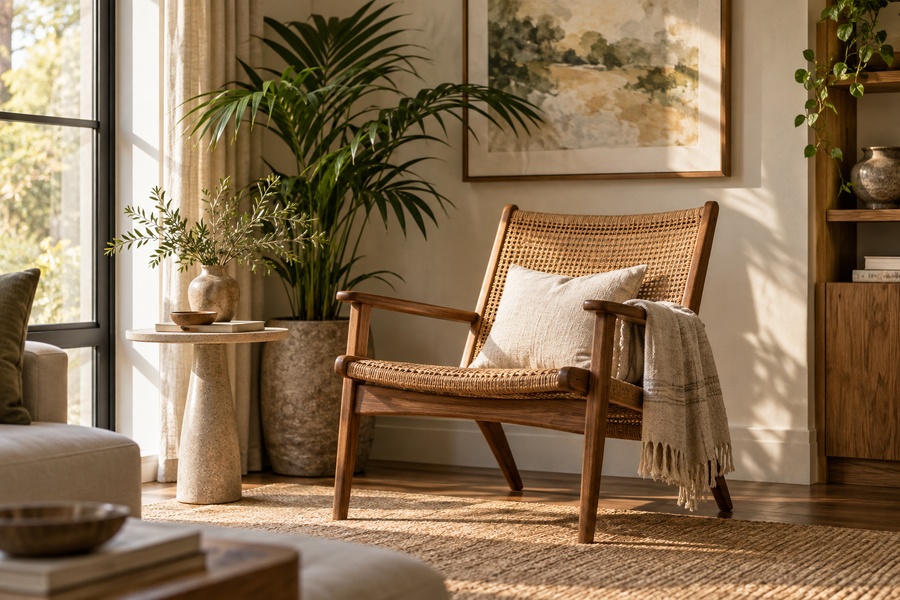
Accent furniture carries an unfair reputation for being decorative rather than useful, largely because so much of it prioritizes appearance over construction. A rattan accent chair with solid wood frame breaks that pattern by combining a genuinely comfortable seat with joinery built to survive daily use. The distinction becomes obvious after a year, when one chair still sits firm and another has begun to wobble at every joint. Knowing what separates the two makes the buying decision considerably easier.
Why a Rattan Accent Chair with Solid Wood Frame Lasts Longer
Frame material determines almost everything about a chair’s working life, because every load passes through those joints thousands of times. Solid timber flexes slightly and returns to position, while particle board and thin metal tubing gradually loosen under the same stress. Mortise and tenon or doweled connections distribute force across a broad surface rather than concentrating it on a few screws. Buying a solid wood armchair therefore protects the investment in a way that finish quality never can.
Repairability follows directly from that construction. A timber joint accepts fresh adhesive and a clamp, which restores rigidity for another decade at almost no cost. Composite panels crumble instead of holding a repair, which is why so much inexpensive furniture reaches the curb after three or four years.
The Practical Case for Woven Backrests
Solid upholstered backs trap heat against your spine, which becomes noticeable during warm months or after any physical activity. An open weave allows air to move through the backrest continuously, keeping the seat comfortable in conditions where a padded chair feels stifling. The structure also flexes slightly under pressure, contouring to your back rather than pressing against it uniformly. A breathable rattan backrest delivers comfort through ventilation instead of padding.
Weight becomes an unexpected advantage as well, because woven panels add far less mass than dense foam and fabric. Moving the chair between rooms takes one hand rather than two people, which encourages people to use it wherever they happen to need seating. Flexibility of that kind quietly increases how often furniture gets used.
Placing a Rattan Accent Chair with Solid Wood Frame in Your Home
Consider the rooms that currently lack a comfortable place to pause, since those are the spots where an accent seat pays for itself. A bedroom corner used for dressing, a hallway beside the entrance, or the unused end of a home office all qualify. Angling the chair toward a window rather than a wall gives the position a purpose beyond decoration. People sit where the view rewards them.
Pair the chair with a surface that matches its scale, because an oversized side table immediately unbalances the arrangement. A small round table or a low stool holds a cup and a book without visual competition. Readers assembling a dedicated quiet spot can follow that idea further in our notes on reading corners built around one chair.
Matching Natural Materials With Existing Furniture
Mixing timber tones worries many people unnecessarily, since natural materials share undertones that allow far more combination than manufactured finishes do. Keeping the undertone consistent matters more than matching the exact shade, which means warm oak and warm walnut coexist comfortably. Introducing one woven element also gives other natural materials in the room something to relate to. The whole arrangement gains coherence from that shared language.
Textiles complete the connection between materials. A linen cushion or a wool throw bridges the gap between hard timber and soft seating without adding pattern. Choosing natural fiber furniture makes those pairings straightforward because nothing needs to match precisely.
Caring for a Rattan Accent Chair with Solid Wood Frame
Maintenance requirements stay minimal provided you address the two vulnerabilities of natural materials, namely dryness and prolonged damp. Positioning the chair away from radiators prevents the weave from becoming brittle over a heating season. Wiping the timber with a slightly damp cloth removes dust, and drying immediately afterward prevents moisture from settling into the grain. Twice yearly attention keeps everything in good condition.
Check the joints occasionally by rocking the chair gently and listening for movement. Tightening any accessible fixings at that point prevents small looseness from becoming structural damage. Owners of handcrafted chair design pieces usually find this five minute routine sufficient for years of reliable service.
Where a Rattan Accent Chair with Solid Wood Frame Fits Long Term
Households change function over time, and furniture that adapts to those changes stays useful far longer than furniture designed for one purpose. A rattan accent chair with solid wood frame serves as bedroom seating, guest seating, desk seating, and eventually balcony seating without ever looking wrong. That range explains why single chairs so often outlast the sofas they were bought to accompany. Versatility beats specialization in most homes.
Longevity also supports a more considered approach to buying, where one good piece replaces several disposable ones. Readers curious about the wider design tradition behind these chairs can explore our overview of nordic seating in minimal interiors. Choosing carefully once remains the most economical strategy available.