Life After Switching to a Self Cleaning Cat Litter Box
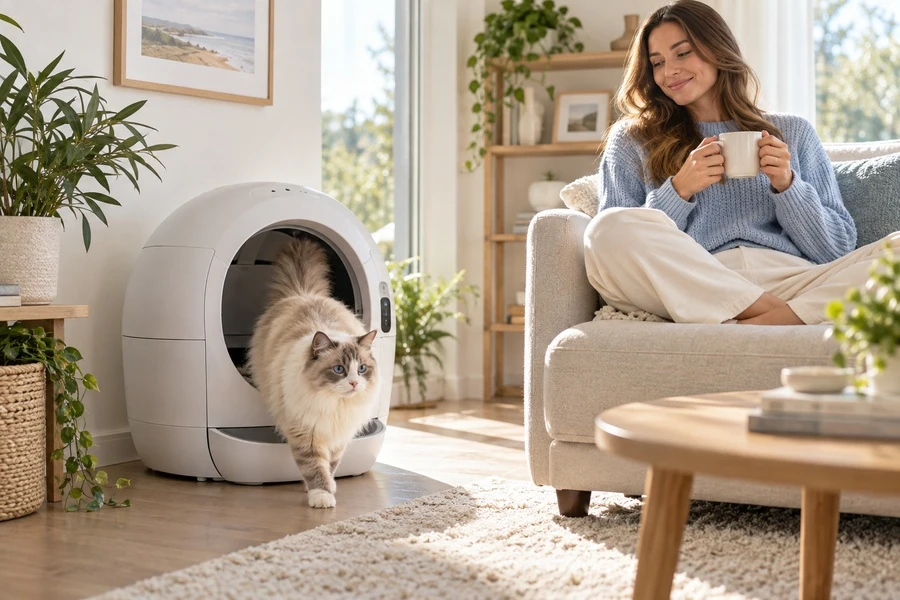
Scooping a litter tray twice a day sounds trivial until you count the number of times it happens in a year, which exceeds seven hundred for most households. A self cleaning cat litter box removes that task entirely by separating waste automatically after each visit and sealing it away from the room. Owners describe the change as unexpectedly significant, particularly those managing early mornings, travel, or limited mobility. Understanding how the mechanism works helps you judge whether the switch suits your home.
How a Self Cleaning Cat Litter Box Works Day to Day
Sensors detect entry and exit, then start a timed delay that allows clumping litter to solidify before any movement begins. A rotating drum or rake then separates the clumps from clean litter and deposits them into a sealed compartment beneath. Clean litter returns to the surface, leaving a fresh tray ready for the next visit without human involvement. The cycle repeats automatically throughout the day and night. Most units complete a full separation within a couple of minutes, which keeps the tray available almost continuously.
Emptying frequency drops to roughly once per week for a single cat, which replaces daily scooping with a brief weekly task. Households adopting hands free litter cleaning often report that the change alters their whole routine around the animal.
Odor Control and Why Timing Matters
Smell develops when waste sits exposed to air, because bacteria break down urea and release ammonia within a short period. Removing waste minutes after deposit interrupts that process before it produces noticeable odor. Sealing the collected material in a closed compartment prevents whatever does develop from reaching the room. Speed of removal matters far more than any fragrance or additive.
Enclosed designs contribute further by containing airflow around the tray itself. An effective odor control litter system combines rapid separation with physical containment rather than relying on masking scents. Homes with limited ventilation notice the difference immediately. Apartments where the tray sits near a living area benefit most from that combination of speed and containment.
Introducing a Self Cleaning Cat Litter Box to a Nervous Cat
Cats respond poorly to sudden change in their toileting arrangements, so patience during the transition prevents avoidance behavior. Placing the new unit beside the existing tray with the power switched off allows investigation without noise or movement. Most cats begin using it within several days once the location and litter feel familiar. Rushing this stage causes the majority of reported failures.
Activate the automatic function only after the animal uses the unit consistently, and choose a model with a gentle cycle. Units featuring a genuinely quiet cleaning cycle avoid startling sensitive animals during the adjustment period. Readers with several cats can review our specific notes on shared use in multi cat households.
Safety Features Worth Checking
Any moving mechanism around animals raises legitimate questions, and reputable designs answer them with multiple redundant systems. Weight sensors halt the cycle whenever an animal enters, and infrared detection covers approaches that occur mid rotation. Automatic reversal on resistance provides a third layer of protection against pinching. These systems operate continuously rather than only during scheduled cycles.
Verify that the delay timer can be adjusted, since a longer pause suits cats that linger after using the tray. Models with proper safety sensor technology allow that customization without complex programming. Confidence in the safety layer determines whether owners actually leave the unit running unattended.
Litter Choice and How a Self Cleaning Cat Litter Box Performs
Automatic separation depends entirely on the litter forming firm clumps that survive movement without crumbling. Clumping clay remains the most reliable material, while crystal and pellet litters often disrupt the mechanism or pass through the sieve. Fine grained products generally clump faster and more solidly than coarse alternatives. Matching the litter to the mechanism prevents most performance complaints.
Depth affects results as well, since too little litter allows waste to reach the base and stick to it. Maintaining the fill line marked inside the drum keeps separation clean and reduces residue. Owners who follow the recommendation find an easy to clean litter unit needs almost no manual intervention between weekly emptying.
What a Self Cleaning Cat Litter Box Costs Over Time
Initial cost exceeds a manual tray considerably, so the value case depends on running costs and time saved across several years. Litter consumption often decreases because clean material returns to the tray instead of being discarded during full changes. Waste bags or liners add a modest recurring expense depending on the model. Most households find the arithmetic works out favorably by the second year.
Time carries value too, since eliminating a daily chore recovers roughly ten hours annually for a single cat household. Readers interested in appearance and placement can continue with our discussion of enclosed designs in shared living spaces. Convenience compounds quietly across the life of the animal.