Inside the Quiet Order of a Modern TV Console for Living Room Corners
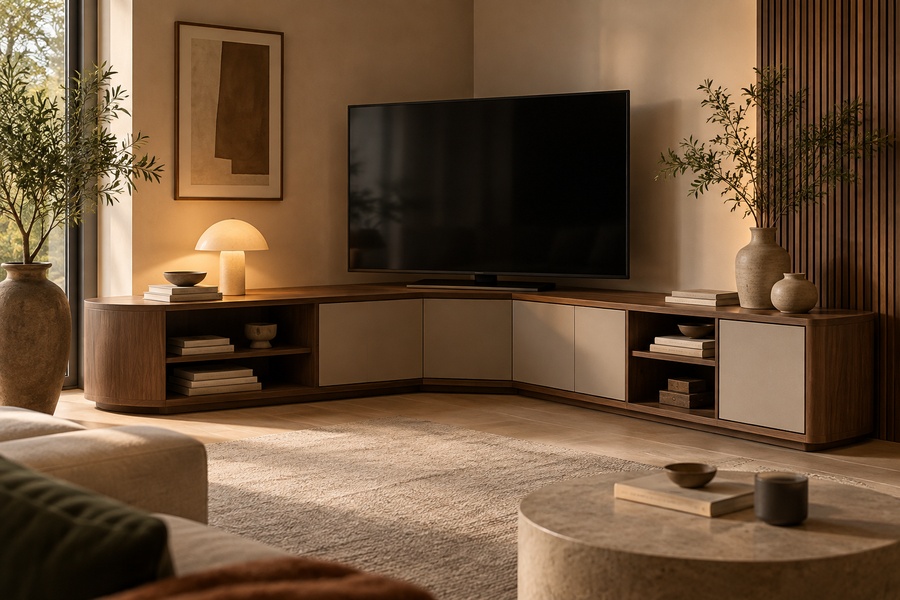
Living rooms rarely become chaotic all at once, since disorder arrives one charging cable and one abandoned remote at a time. A modern tv console for living room use interrupts that process by giving every loose object a designated place within arm’s reach of the sofa. The result is not merely tidier but calmer, because visual clutter demands attention even when nobody consciously notices it. Choosing the right piece involves thinking about behavior and habits rather than dimensions alone.
How a Modern TV Console for Living Room Use Restores Order
Storage succeeds when putting something away takes less effort than leaving it out, which is a low bar that most homes still fail to clear. Drawers positioned directly beneath the screen mean a controller travels twenty centimeters rather than into another room. Closed compartments hide the visual noise of chargers and adapters, while an open shelf keeps frequently used devices accessible. Practical living room storage solution thinking beats decorative baskets that nobody actually opens.
Households with children benefit even more from this arrangement. Toys, craft supplies, and school materials disappear into a single cabinet during the evening reset, which takes a couple of minutes rather than half an hour. Consistency matters more than capacity, because a system people can maintain daily always outperforms an elaborate one they abandon.
Proportion, Balance, and the Line Along Your Wall
Interior designers talk about horizontal lines because they govern how large a room appears from the doorway. A long low cabinet stretches the perceived width of a wall, which is particularly useful in rooms that feel narrow or boxy. Breaking that line with tall objects at both ends creates symmetry, while grouping items at one end produces a more relaxed asymmetric look. Either approach works provided the choice is deliberate.
Material selection influences the same impression. Pale wood tones recede visually and suit smaller rooms, whereas darker finishes add weight and anchor larger spaces. A sleek horizontal console in a matte finish tends to photograph and live better than a glossy alternative that reflects every lamp in the room.
Fitting a Modern TV Console for Living Room Layouts With Awkward Walls
Few living rooms offer one perfect uninterrupted wall, and most contain a radiator, a doorway, or a window in exactly the wrong position. Measuring the usable run between obstacles gives you a real maximum width, which often differs from the wall length by a surprising margin. Corner placement solves some layouts by angling the screen toward the seating while keeping the cabinet against the longer wall. Working with the room as it exists produces better results than fighting its geometry.
Power outlet position deserves early attention because relocating a socket costs more than most people budget. Leaving a small gap behind the furniture allows plugs to sit without bending, which protects both the cable and the wall. Readers dealing with a particularly long wall may find the sizing discussion in our piece on two meter cabinets beneath large screens helpful at this stage.
Sound, Screens, and Everyday Technology
Audio equipment changes the requirements considerably, since a soundbar needs a clear shelf at the correct height without blocking the infrared receiver on the television. Leaving the top surface clear directly in front of the screen accommodates most models comfortably. Buyers planning an upgrade should confirm the depth available before purchasing, because deeper bars overhang shallow furniture. Selecting soundbar friendly furniture at the outset avoids a frustrating compromise later.
Heat and ventilation remain relevant for any household running a console or streaming device continuously. Compartments with open backs allow air to circulate rather than trapping warmth around the electronics. Equipment that stays cool runs quieter, throttles less, and lasts noticeably longer.
Choosing Finishes for a Modern TV Console for Living Room Use
Furniture in a living room absorbs more contact than almost anything else in the house, from mugs and laptops to feet propped up during a film. Surfaces with a durable coating resist ring marks and light scratches that would ruin an untreated finish within months. Edges take the most punishment, so rounded or banded profiles hold up better than sharp exposed corners. A modern wood finish cabinet should still look presentable after several years of ordinary family use.
Cleaning requirements stay minimal with the right finish, which usually means a dry cloth weekly and a slightly damp one occasionally. Avoiding harsh sprays preserves the coating and prevents the dull patches that appear on over cleaned furniture. Longevity comes from gentle habits rather than aggressive maintenance.
Why a Modern TV Console for Living Room Spaces Pays Off
Value in furniture shows up as the number of problems a single piece quietly solves over its lifetime. A modern tv console for living room use handles screen support, device storage, cable control, and general household overflow simultaneously. Replacing those functions individually costs more and produces a less coherent room. One considered purchase therefore does the work of several partial ones.
Consider the resale and reuse potential as well, because a well built low cabinet moves easily into a bedroom, hallway, or home office when your setup changes. Readers thinking about proportion and ceiling height can explore that angle further in our discussion of low cabinets in compact rooms. Furniture that adapts rarely becomes waste.